It is as if there existed, for what seems like millennia, tracing back to the very origins of mathematics and of other arts and sciences, a sort of “conspiracy of silence” surrounding these “unspeakable labors” which precede the birth of each new idea, both big and small, and which thereby lead to a renewal of our understanding of a portion of this world in which we live, a world engaged in perpetual creation.
Recoltes et Semailles, Grothendieck, A., 3.6, English translation.
The fascination of thinkers and polymaths with “tides, winds, ocean flows, rise of sea level; fluids in general” dates back to the early periods of scientific revolution (16th and 17th century) and the age of enlightenment (18th century), when the phenomenon of attraction between big, bulky objects in the heavens and their motion was given light to by Newton’s calculus (keeping aside the controversy around the priority disputes of calculus). Newton’s views on fluids were both mixed and unclear: he had proposed both a molecular model where particles impact upon each other (leading to his famous law of resistance being proportional to the square of the velocity multiplied by sin-squared of angle of attack; the square on the sin term turned out to be later wrong for subsonic flights) and a continuum model for the fluids without any voids in between (elaborated historical discussion is available in Truesdell 2018). Berlin Academy in 1748 went forward to follow and improve upon Newton’s footsteps and proposed the theory of the resistance of fluids as a subject for the prize competition, knowing that Newton’s theory of the sine-square law of air resistance is wrong. Subsequently, d’Alembert in 1749 submitted his entry, concluding with the now-known physical paradox, the d’Alembert paradox, which leads to a strictly vanishing drag force in the theory of potential flow. The director of Berlin Academy, Leonhard Euler, who sent back all manuscripts and gave no prizes, including d’Alembert’s submission (being a non-resident member, d’Alembert withdrew and published the essay later on independently), was known to be highly preoccupied with the pure pleasure of mathematics, and considered the questions of mechanics and physics only secondary to his predominant passion. Such a culture divide would later become more explicit, when the field of hydraulics and theoretical fluid mechanics had their unfortunate split, famously explained by Sir Cyril Hinshelwood (cited here) as
hydraulic engineers who observed things that could not be explained and mathematicians who explained things that could not be observed.
Regardless of the split, the history of fluid mechanics in the enlightenment and pre-industrialisation age saw the arrival of many thinkers, D. Bernoulli (most notable for the derivation of Torricelli’s law, and later, Bernoulli’s law) in his treatise Hydrodynamica, L. Euler (notable for applying Newton’s kinematic theory for a continuous medium in presence of arbitrary external forces, compressible or not, for fluid with three degrees of freedom flow, in his 1757 treatise), C.L.M.H. Navier (noted for introducing the notion of restoring forces in hydrodynamics through a new force in his 1822 memoir), A. Cauchy and S.D. Poisson (who notably fought with Navier to obtain a strict and rigorous Laplacian molecular approach; outlined nicely in this article; Cauchy found the coefficient of to be 1 instead of 2), and G.G. Stokes with the year 1845 often attributed as when he published, in the Transactions of the Cambridge Philosophical Society, his article on the theories of the internal friction of fluids in motion, and of the equilibrium and motion of elastic solids (updated version here). The eighteenth-century culture of science communication did not remain far enough from explaining the basics of hydrostatics and hydraulics to children and young learners through a series of dialogues between the members of a family, as evidenced in the book, “Rudiments of reason; or, the young experimental philosopher” (c.f., introductory pages) printed for E. Newbery in London in 1793.
Outside the science community, the fascination of fluids spread throughout, to every continent, country, region, culture, and household – be it through common medieval dictum of separating storage vessels for drinking water from bathing water (a few names are: ibrik, olla, zeer, qirbah, and ewer), or through a bicycle tyre repair mechanic’s dictum of intuitively knowing how far the valve needs to be opened while filling up air in the punctured tyre of a cycle (which is loosely a function of the type of bike, the specific season of that specific country you are filling your tyre in, and numbers are communicated in the units of psi), or using Bernoulli’s principle to siphon out the water from a liquid tank or pool placed at a certain height above the ground, by sucking in and building a relative negative pressure on the lower end of the tube, acting as an outlet; we all have some level of innate rigour and knowledge within us, when it comes down to dealing with fluids. In fact, if we turn our attention inside ourselves, the vortex rings are formed in the left ventricle of the human heart during cardiac relaxation when the jet of valve enters the mitral valve (in fact, the recoil force generated during the vortex propulsion is found to be smaller for diseased cases of dilated cardiomyopathy and stenotic valves, in comparison to the healthy case); the immature vortex rings are key to understanding if our hearts have a good health or not. It is not just humans but animals also who have evolved to use fluids for their advantage. Be it phalaropes and other shorebirds generating vortex by swimming in circles to feed in small crustaceans and other invertebrates and opening/closing the beak in tweezering motion to transport prey-laden droplets by a capillary ratchet/contact-angle hysteresis mechanism (Prakash et al. 2008), or the legs of Gerridae striders who support their weight on the surface of ponds, rivers, and the open ocean, by making use of the surface tension force generated by curvature of the free surface (Hu et al. 2003), or the carnivorous pitcher plants like N. rafflesiana which imprint tiny portions of their digestive, viscoelastic fluids onto the surfaces of insects fallen inside them, and thus effectively resisting dewetting, making it energetically difficult to come out from the stomach of the pitcher plant (Kang et al. 2021), it could be safe to say that the water being much older than the life on Earth, means that we have adapted to live peacefully with and around it.
The advancement of mathematics, science, technology, and society in totality, has evolved in tandem with our evolving understanding of fluids. On 16th July, 1945, prior to the Hiroshima and Nagasaki incident, the Trinity test in New Mexico saw a release of a mushroom cloud as high as 40,000 feet in about 7 minutes. A famed fluid dynamicist, G.I. Taylor, used the scaling analysis to guesstimate explosive yield of of the bomb in terms of density of the undisturbed atmosphere, radius of shock wave, and the time since the blast. This dimensional analysis helped him arrive at the number of 16.8 kilotons of TNT, close to the value 18.6 kilotons reported by DoE. Extending afar to the field of biofluids, E.M. Purcell in his famous paper, Life at low Reynolds number, derived Scallop’s theorem which states that in the Stokesian (low ) limit, a reciprocal stroke with a single degree of freedom cannot generate a net displacement over one cycle; for example, a scallop consists of one hinge which upon opening and closing in one period isn’t enough to cause its net migration in the fluid. Fluids, governed by the Navier-Stokes equations, also inspired and ignited a lot of interest of mathematicians in the theory of PDEs. Oseen, Leray, Hopf, and Ladyzhenskaya are often credited with working on the Navier-Stokes solutions by stepping away from the classical approach of guaranteeing uniqueness of a solution. The use of weak solutions was so unusual in those times that Ladyzhenskaya recalls:
I still remember years (the 1940s and 50s) when the majority of maîtres (and first and foremost I.G. Petrovskii) regarded a problem as unsolved if on the chosen path of investigation the researcher did not guarantee the existence of a classical solution.
It is worth noting that Jean Leray in 1934 had used introduced the concept of generalised derivatives in the sense of distributions, which are Lebesgue measurable, square-integrable, with a generalised square-integrable gradient (later to be known as the Sobolev space) in his much celebrated global weak, finite energy solution to the 3D Navier-Stokes equations and keeping the smoothness question open since then, and he later was captured in 1940 and held as a prisoner of war until 1945; where he laid down the foundations of sheaf theory and what was to become foundations of modern algebraic geometry (miles away from the theory of PDEs, Navier-Stokes, and analysis, for the fear of being labelled as a mechanician and helping German authorities in the camp and thus, delving it into his secondary interests of algebraic topology as known by at that time).
The chaos theory in the mid 20th century helped in pushing forward the applied analysis of fluids, through the lens of computers, such as by the dynamical simulations, where the initial conditions were to be regarded as enough sensitively powerful to create reproducible structures on the screen; the phenomenon of the Lorenz system, chaotic advection, elastic turbulence, stirring of dye in water (low Re chaotic advection), strange attractors in the chaotic dynamical systems prevalent in metereology and hydrodynamics, and much more. Charles E. Doering and J.D. Gibbon are often regarded as bridging the gap between mathematical and applied fluid dynamics, and their attempt in this direction is apparent in the celebrated book Applied Analysis of the Navier-Stokes equations, where in Chapter 9, they derived estimates on the spectrum of the linearised evolution operator around solutions on the attractor, and thus using 2D Navier-Stokes equations to derive a global attractor; this approach fell short to be used for the 3D Navier-Stokes equations because of the lack of the regularity proof and thus that of the existence of a compact attractor (ref. Ch. 9). Towards the end of 20th century, Cristopher Moore’s program of undecidability suggested an alternative approach of considering motion with at least three degrees of freedom as equivalent to a Turing machine, and thus more notoriously difficult than a low-dimensional chaos for example.
Though the papers and examples cited above are picked by the author’s personal taste of interest and relationship with the field, what is undebatable is the ever-evolving science of PDEs which saw many schools of thought flourishing over the past many decades, and its percolation to many applied disciplines, such as, computational fluid dynamics (Basilisk CFD software based in Paris is known for promising solutions to PDEs on adaptive, Cartesian meshes), engineering fluid dynamics (GALCIT, Caltech, known for inventing numerous wind tunnels in mid 20th century), physics of fluid dynamics (DAMTP, Cambridge, UK, known for housing the community of Journal of Fluid Mechanics; started off by G.K. Batchelor), and the most fundamental and uniting of them – the mathematical fluid dynamics. The community of mathematical fluid dynamics had always acted as a shining and guiding light on the landscape of PDEs and fluid dynamics, and with the coming of results from the greats of O. Ladyzhenskaya (her paper on the relevance of millennium problem and Ladyzhenskaya-Prodi-Serrin (1959P, 1962S, 1967L) condition on uniqueness and smoothness of solution in positive time when the Leray weak solution lies in with ), P. Lax (most noted for the Lax pair), Caffarelli-Kohn-Nirenberg 1982 paper on obtaining singular set of suitable weak solutions with zero 1D parabolic Hausdorff measure, Beale-Kato-Majda 1984 paper on that the Euler and Navier-Stokes smooth solutions continue as long as, V. Sverak (Heinz Hopf prize winner and known for improving L-P-S condition for ) in the Escauriaza-Seregin-Sverak 2003 paper (unforced regularity), G. Seregin (most noted for his lecture notes and the L-P-S condition), E. Titi (the course on the mathematical theory of the Navier-Stokes equations), J. Bourgain (norm inflation for Euler equations in endpoint critical Sobolev spaces; paper), P. Constantin (early years of the regularity theory of Navier-Stokes – vorticity direction, Onsager’s conjecture, local smoothing properties, disseminating the importance of the millennium problem), T. Tao (for constructing artificial blowup using dyadic shell model), T. Buckmaster (Clay Research Award winner for his Buckmaster-Vicol 2019 paper on the non-uniqueness of weak solutions of NSE using convex integration and recently crucial in obtaining the counterexample for smooth forced Euler equations on ), Albritton-Brue-Colombo 2022 paper on the non-uniqueness of Leray solutions with a force, from an unstable vortex in similarity variables, and many other thinkers, who produced results of important kinds. New tools, techniques, philosophies, and subschools of thoughts percolated. To list a few, the traditional school of analysis is divided into the former school of uniqueness results, followed by a shift towards non-uniqueness results, surrounded by the mature school of convex integration (due to Camillo de Lellis, Laszlo Szekelyhidi Jr.), the young school of symplectic geometry (due to Eva Miranda, Daniel Peralta-Salas), the school of numerically stabilised PDEs solution certification (Thomas Hou, most noted for Luo-Hou 2014 on axisymmetric Euler in a cylinder with smooth data, self-similar profile, and and Chen-Hou 2022,23 on computer-assisted proof of stable nearly self-similar blowup of 2D Boussinesq, 3D axisymmetric Euler with smooth data and boundary), the school of PINN blowups (George Karniadakis), and slightly more abstractly, analysis-free analysis in Bonn and Copenhagen (more recent and isolated from rest). This is not to forget the permeation of some of these ideas into applied disciplines; every mathematical fluid dynamical idea has had its application somewhere lying dormant in the physical world, it is just that someone would now and then work hard and appreciate it to bring it about. Collaborations like Constantin–Dupont–Goldstein–Kadanoff–Shelley–Zhou, Moffatt–Kimura, Charles R. Doering, Sharma–Wilson, and many results from the turbulence community (Majda, Kato, Beale, Dubrulle, Gibbon, Eyink; an example workshop for suitable references) are of those kind.
The current state of affairs is very unsettling and tense to me. The source of joy of the unknown around the Navier-Stokes millennium question and the source of silence that permeated us all has dramatically vanished in a shocking state of affairs and in a matter of few days and with vast amount of financial and computational resources deployed by OpenAI. Terry Tao has likened the OpenAI’s approach to treading one’s way to the end goal like a fast-paced automobile in a highway, without caring at all of proof digestion, proof exposition, proof canonicalisation, and proof publication. The community usually would have been happy and excited and positively surprised and happy about it – and there is indeed a first-order emotion of happiness in all of us, for the announced machine-generated proof, accompanied by a Lean formalisation would let us investigate the theory of Navier-Stokes equations in a more goal-directed manner (it is importantly noteworthy that the announced construction produces finite-time singularity for the three-dimensional Navier–Stokes equations with smooth forcing, thereby addressing the breakdown alternatives (C) and (D) in the Clay formulation; while being different from exhibiting blow-up for the familiar unforced Cauchy problem). But there are much higher-order, nuanced emotions in the mathematical community of a loss of mathematical culture, child’s play, and muddy-sluggish-inconsistent way to live one’s life around mathematics and mathematical questions; it is this spirit that had previously let us all live and stay close to the “silence” that had weirdly conspired to “force” us to work hard and give birth to each new idea for past many millennia, both big and small, and renewal of our understanding of a portion of this fluid-world in which we lived for centuries, a world engaged in perpetual creation (borrowing Grothendieck’s language here, for the lack of better words).
What lies ahead in the world of fluid dynamics, in the world of PDEs, and in the world of Navier-Stokes is unclear, unsure, and unknown to me, now that the shining and guiding light on the landscape is gone, and the most recent status around the proof is that is in “incomprehensible” to the community (though that should change soon to a better end). Things seems bearish from this point onwards, to choose the language that the ones who caused this prefer to use. The incentive structures concentrated in the Bay Area and in the frontier-AI industry more broadly do not appear particularly inclined to preserve stories of human endeavour, and in fact do not care to snatch more of such stories of centuries, if not millennia, of human endeavours in a fraction of a second, and use the winds of derision to leave us with soulless new foundations and abandoned construction sites (quoting Grothendieck again from Recoltes et Semailles, 3.6); for us, the chisel-and-hammer workers to sit, beautify, paint, colour, and fill with purpose, warmth, meaning, judgement, understanding, and a collective-consciousness-fabric. In the words of Terry Tao and his talk at SAIR, Caltech on 11th Sept, 2026, the steps following proof verification, of that of proof digestion, proof exposition, and ruminating on the impact of the proof on the adjacent fields seem to be all arid lands and empty at the moment. Broadly, there are a few suggestions to move forward: the mathematical community is suggesting to come together and design our own LLM, directed to our academic interests, an outcome of the declaration regarding misalignment; SAIR has proposed to hold new LLM-free mathematical challenges; mathematical discourse video journal to give a talk on the problem, and inviting or asking the first person to give a mathematical insight on a machine-generated proof. In addition, call for slow down and not bringing the time factor (influenced from market) into the rest open problems are on the rise (c.f., statements like “What has RH anything to do with 10 years?” (Music of the Primes, p. 215) are at risk of losing their purity). Alain Connes has nicely suggested to not let AI take the agency of brain to be able to create mental images for them. A few decades ago Grothendieck had felt something similar (albeit in a different setting) when he outlined his experiences in the following paragraph
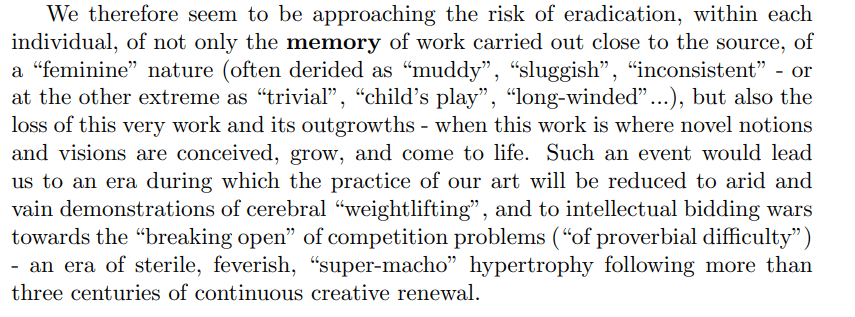
While a lot of suggestions have been in the forefront, such as ignoring the fear-mongering tactics of the AI industry, building a community-owned academic LLM, not caring much about the machine solution and doing mathematics at one’s own pace like before, adjusting the economy of doing mathematics, the issues that lie ahead in the context of Navier-Stokes to resolve are, how the new proof – once out with a decent digestion and explanation – helps one to think about arriving at an updated theory of PDEs, aids us in obtaining better predictive models in turbulence, tease out any underlying algebraic structure in the Navier-Stokes equations that might have been lying waiting to be discovered underneath these hundreds of pages of calculations, and last but not least, investigate if a curiosity-inspired question like Navier-Stokes regularity has a real-world application (which I believe it to be the case; c.f., unreasonable effectiveness of mathematics, E. Wigner).
I choose to end this blogpost by scaffolding an old quote by Grothendieck with a modern, photoshopped imagery.

Crossposted from my blog. See also a related video by Quanta.
Received 17 September 2026.

Add to the discussion