Recently I wrote a reply to “The AI dissenter viewpoint” and was encouraged by the author and Yemon Choi to contribute my response as a separate post. I’ve also become concerned with the extent of absolutist and highly-charged comments regarding those who do not conform to others’ views on this matter. So I figured it might be useful for someone who shares more moderate views to see them laid down on paper and know they are not alone.
This article is divided into two parts. I will begin with my own experience and perspective around math and AI. Then I will call attention to the economic anxieties that motivate much of this discussion and examine some common talking points that have been discussed.
The usual disclaimer: the views expressed here are solely my own and do not represent the position of my current employer. I welcome feedback and challenge. I genuinely want an exchange of perspectives, and I am thankful to everyone who takes the time to read this.
Will no one think of the truffle pigs?
I am a data scientist and I would, in good-humor, call ourselves the truffle pigs of mathematics. We forage through papers in search of new ideas to bring to life in real-world applications. This is the “public” is that everyone appeals to when discussing the impact of mathematical research (or at least, one part of the public). Data scientists and academic applied scientists are those who stand downstream, and it is for this reason we care so very deeply about the health of the math community.
If I can’t find what I’m looking for in the existing literature, I must decide whether to forego that line of inquiry or roll up my sleeves and create it myself. Given limited resources and the time-consuming nature of advancing mathematics, this issue comes up more often than many may appreciate. That’s precisely what happened with varentropy. For those who don’t know, the concept is not exactly new, but it has been primarily treated as an ancillary notion in information-theoretic proofs (think Asymptotic Equipartition Property). It has been known for 25 years that varentropy is intimately connected to the rarity of outcomes produced by a distribution [1] and, in some settings, can be thought of as “a measure of fattailedness,” as Dr. Taleb put it.
When you google “varentropy,” though, you notice that the literature is quite sparse, even though it is of great interest to practitioners, because statistical tools for fat tails and extreme events are notoriously hard to use in practice and any viable alternative would be most welcome. The issue is that proving theorems about varentropy requires a highly non-trivial understanding of analysis that is usually out of scope for a classically trained statistician. The question is: what should we do when analysts are simply disinterested in applications and academic statisticians are too busy with Bayesian methods? Should we just give up and wait another 25 years until someone starts paying attention to what practitioners need?
My hope is that AI can be leveraged by academics and practitioners alike to advance more knowledge within the community in a world of seemingly dwindling funding and increasing demands on our time. To help illustrate this point, some of those resource-efficiency applications are sketched out below:
- Improving the speed of iteration. In my view, the greatest value of AI is not in the material that gets published, but in the material that will never be published. AI allows researchers to iterate through ideas more quickly, which is especially useful for less experienced researchers who may spend significant portions of their time on dead-ends. Not wasting months of one’s life on a wild goose chase is the perhaps the greatest gift of AI.
- Proof formalization and automation. While a feature that is clearly further down the line, it is worth discussing now. The appeal of proof automation and formalization for researchers and practitioners in applied fields is practically irresistible. Namely, formalization could drastically speed up review and let people spend their time on questions that are impactful in their respective fields. For example, in statistics the main questions are statistical, not purely mathematical, just as in physics or drug discovery. Yes, there are important caveats, such as the fact that translating from informal languages to formal ones and vice versa — i.e., verifying that the program actually proves what it says it does — is difficult in itself. But where there is a will, there is a way. This may not apply to pure math, but in the applied sciences sometimes a proof is just a proof.
- Helping researchers understand arguments outside their domain. Real-life projects are often multidisciplinary and require expertise drawn from different fields. Any tools that help researchers bridge knowledge gaps in adjacent fields is incredibly valuable. It can allow for smaller teams to achieve more impactful results.
- Automation of mundane tasks. So much of our lives are spent on boring, repetitive tasks, like writing boilerplate code and text, that take away from the jobs we really want to do. The less time writing a grant proposal is more time doing the actual research you entered the field to do.
Despite what many may otherwise assume, those in industry do theoretical work all the time. They just don’t publish it. Sometimes it’s to protect trade secrets. But more often, it’s because the resource-intensity of publishing is too much, and the incentives too little. One needs to organize an entire road show to convince members of a different community that their work is worth looking into. Since there is no financial incentives to publish, it’s an act of public service on a part of industry members.
I hope alleviating some pressures of publishing with technological means will encourage qualified professionals to donate their time and effort to publish and give back to the pool of common knowledge. There is no other mechanism, outside of peer-review, that provides a disciplined examination of new ideas and methodologies. But convincing people to contribute is unbelievably hard and the opposition from the other side does not make it easier.
Economic anxieties play a large role in the discourse
As Yemon Choi noticed, my original response relies on implicit assumptions of its own. So let me make the most fundamental one explicit: the conversation about AI is a conversation about economic impact, and the main anxieties are economic too. What I like about “The AI dissenter viewpoint” is that it acknowledges this with refreshing honesty — even if the economic argument is then repackaged as a moral one.
In many cultures, talking about money is deemed unseemly. But if we want solutions, we first have to name the problem. And the problem is real: there is nothing wrong with being concerned about your livelihood — other professions, like lawyers and data scientists, have these concerns too.
But it did not start with AI and it will not end with banning AI. There are plenty of forces besides LLMs squeezing funding: see “Unexpected Unemployment”. If you have never read it, please do.
Early-career mathematicians will leave en masse in the next 5 years
It breaks my heart, but the problem started long before LLMs. Yours truly was once an applied math PhD student at Stony Brook. I won’t recite my personal drama; I will only say that it is much easier and more pleasurable to think about math from a position of relative financial security.
So what do you do about funding when you don’t have any? Ask someone to close some gaps, and redistribute resources to close the rest. Schools in the US should look at what their colleagues abroad are doing and consider industrial PhDs and PhDs by publication. In my view the industrial PhD should be the norm in data science. It is odd that a person teaching data science can spend an entire career without a single day in the field. In that regard, data science is closer to law than to math: it is not a spectator sport. And let’s face it, the majority of PhDs in the field never end up teaching, so why not endow them with the skills they actually need?
That would require relinquishing some control over PhD students and post-docs in favor of informal cooperation. Obviously no one likes relinquishing control, but cooperation between academia and industry is the best way forward.
What works for data science would not work for everyone — I lack the imagination to see how it applies to pure math. But the resources freed up by sharing PhD students with industry in applied fields can supplement funding in the purer parts of math. The decimation of the pure math community will hurt everyone. I can’t do my work if the upstream ideas produced by analysts and by people working on special functions and CAS dry up.
AI talking points
Since I promised a post about AI, let’s rebut some ideas that relate to AI directly.
“advancement of AI” = “accumulation of power in the hands of big tech companies”
There is nothing inevitable about frontier models belonging to a handful of private companies. We could conceivably have open, public, EU AI. Open-weight models already demonstrate impressive capabilities outside the walled gardens — and a user of an open model benefits no company at all, which tells you the real complaint is about market structure, not about the technology and not about proofs. I don’t want to pick on this particular essay; I see the false equivalence everywhere. Can we not separate technological advancement from its current beneficiaries, as happened with electricity, cars, antibiotics, and the Internet? Why not ask instead where the open and ethical response from actors like the EU is, how the frontier market became a concentrated oligopoly, and what we can do to change that?
I am fairly confident that open source is the future, for a simple reason: open source is good for business (just not OpenAI’s and Anthropic’s business). In this fight you have unlikely allies. Many US enterprises are deeply concerned about their trade secrets flowing to AI labs, and they are about to surrender control over the means of production — see a recent interview with Alex Karp on CNBC, where he channels these anxieties. It is quite ironic to hear big American businesses talk this way about the means of production, but once you see past the irony you start seeing an opportunity. To be clear, I am not asking you to work with Alex Karp; I am asking you to entertain the notion that there are plenty of businesses around you that want the same thing you do.
Wouldn’t it be nice to thank Sam Altman and Dario Amodei for their invaluable contributions to technology and then switch to open source models? Where there is demand, supply will follow.
As a result, vast inequities result for mathematicians in different research niches and with differing access to models.
I am very sympathetic to the inequality argument, but the solution is to build more ethical and equitable tools, preferably open source ones. And AI subscriptions are not even the most egregious example. Everyone knows the cost of access to academic literature, especially outside Western universities. Fewer people notice what access to CAS systems costs. Yes, there is SymPy — and with all my appreciation for what it takes to run such a project on a zero budget, it lacks properly implemented logical entailment across the system and is not a substitute for a production-grade CAS. CAS systems are fundamental to the day-to-day practice of data science and currently have more impact than all LLMs combined. Not as “hot” as AGI, but something I think about every day.
People need to believe they add value to our field. If LLMs become more capable at generating new proofs than human mathematicians, then many people will not choose to work in mathematics.
This concern is predicated on equating “theorem proving” with “doing mathematics.” Proofs are only part of the work: choosing which questions matter, building conceptual frameworks, and connecting fields remain deeply human tasks. People will not lose interest in knowledge; assistance with proofs will help them produce more of it, guided by vision and conceptual understanding.
There is also a wider view worth taking. Pure mathematicians are a small fraction of scientists and public support for research carries an expectation of value in return. Many scientists downstream stand to benefit from accelerating their own knowledge-production chains; a field-wide norm against these tools would impose real costs on them as well.
Does reading AI-generated mathematics full-time sound like a profession or a hobby?
Fair question, but it is worth remembering that professions are defined by the value they deliver to others, not by which tasks the practitioner enjoys. If the conclusion is that the remaining work is not worth paying for, the remedy is not that the public owes you the enjoyable version of the job. Reinvent yourself and find a way to be useful to the people around you.
The same applies to “Is refereeing papers your favourite part of your job?” How much practitioners enjoy particular tasks cannot be the criterion for public funding. And the rebuttal offered on this point leaves the underlying question unanswered: why the public should pay you for research if you refuse to use all available tools to produce the best research possible. If your answer is that you actually provide education and “ancillary benefits” — fine. Then be funded and evaluated as educators, and stop taking grant money for research. Appealing to some intrinsic benefit of having a large community for the sake of having a large community is not a satisfying answer: by that logic the public should fund any large gathering of educated people who occasionally teach.
Mathematicians are directly disincentivized to communicate and disseminate their ideas because they can be scooped by LLM users. People are incentivized to either quickly publish lower-quality work or to fully flesh out a theory entirely alone and then drop a 100-page mathematical monograph. Various actors will pollute the commons in the near future by quickly producing and generating mathematical work using LLMs and releasing it without refining In short, we should expect that all the worst aspects of the publish-and-perish model will be exacerbated in the near-term LLM regime.
These concerns say more about academia’s rewards system than about the perils of tech adoption. As the essay itself notes, these are “the worst aspects of the publish-and-perish model.” That model predates LLMs by decades.
What if publish-or-perish was not great to begin with, and the publication process could be greatly refined? What if we paid reviewers, for once? I, for one, would love to pay reviewers if I knew it would incentivize them to thoroughly evaluate my work, as opposed to keeping it in a desk drawer for three months because they personally are not interested in the subject. It is also absurd that the system relies on unpaid labor. In fact, I believe there is a term for that.
It was a culture shock to learn that a year in review is normal. Some highly important papers sit on arXiv for many years, and I still don’t know whether the result is true. Meanwhile, I need to work somehow. This is not excessive rigor at work but a result of a clogged system.
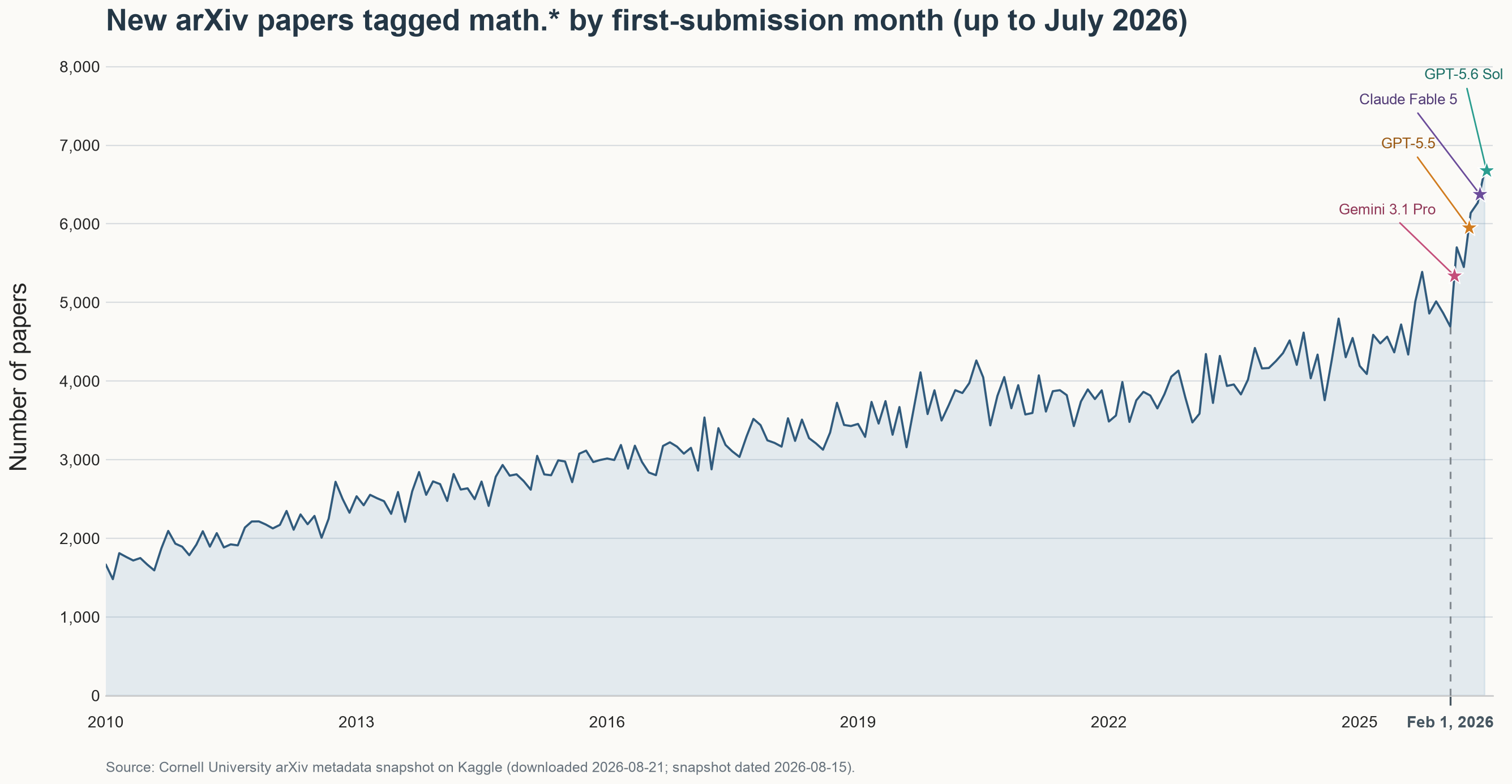
A common trope blames the clog on the explosion of AI slop. If not for these barbarians at the gate and their vile slop machine, we would be living in clog-free publishing bliss. Well, it is not at all self-evident that LLM slop has materially changed the pre-existing exponential growth trend in publication volume.

One could probably build a changepoint model to argue for the impact of “slopification” on volume, but, again, it is not self-evident.
Another talking point : AI will create paper mills on steroids — papers that are correct, and contributions to science, but that their own authors do not understand.
Three (mostly) objective criteria for the quality of a paper are novelty, correctness, and impact. The desire to gaze into the author’s soul and determine whether they “truly” understand the material strikes me as misguided. The whole point of publication is to make a contribution to science. If a paper is novel, correct, impactful, and passes peer review, then it’s a legitimate contribution to the field. Other people benefit from it.
Questions about author’s knowledge are better addressed during the hiring process. What forces you to hire incompetent people?
Comments on Giorgio Mangioni’s “A viewpoint on ‘The AI dissenter viewpoint’”
Let me also touch upon some points raised in Giorgio Mangioni’s “A viewpoint on ‘The AI dissenter viewpoint“.
At this point two mathematical communities would emerge, each with their own internal deontology and even different epistemology: the human mathematical network (us), trying to do business as usual, and another pole centered around companies, whose increasing output of mathematics might look as rigorous as the human ones to the general public, and even to experts as models become more and more convincing Seeing the two poles compete would surely erode the public trust in mathematics and the self-correcting way of doing science. In the clash between the two systems, I expect people would be more easily swayed by technogurus than by what they perceive as an old institution which refused to “upgrade”. This is arguably a far-fetched scenario, but still one I’d want to avoid.
I would say there is nothing far-fetched in this scenario. Every time academia ignores the needs of practitioners, it fuels a considerable urge to create an alternative system of knowledge production, because those needs must be fulfilled somehow. If you do not create the tools I need, I have to make them myself. AI just makes it easier.
That is why dialogue and cooperation are important; not everything is a competition. Life is much easier with bridges and revolving doors.
To make sure that all mathematicians have equal access to generative tools, we might decide to give AI companies access to ArXiv only in exchange to free institutional access to the pro models.
First, let’s address what arXiv is for and who its audience is. The whole point of arXiv is open access to knowledge — partly to advance the discourse within the academic community, but also so that applied scientists and data scientists can find the nuggets they are looking for. AI summarization helps digest an increasingly large volume of information. Cutting arXiv off from AI altogether would turn it into a messaging platform for the authors’ own research circles, because only they have sufficient prior knowledge to read the papers quickly.
If you are concerned about the misalignment of economic incentives between academia and big tech companies, a better solution is to build an alternative AI model. American universities have multibillion-dollar endowments — perhaps uncharitably, one may call them hedge funds with a few research departments attached. There is no reason whatsoever why a consortium of large, powerful US institutions cannot build its own model and equitably distribute the gains. Such project could be supplementally funded via a subscription model for members of the public outside academia. It makes no economic difference to me whether I pay $200 a month to OpenAI or to a Stanford + MIT + Columbia consortium. And there are precedents for large-scale global academic cooperation, like CERN.
First, we need to say goodbye to learned helplessness; then everything is possible.
We might surely learn a thing or two from influencers and content creators, especially those who already popularise deep mathematical results.
Could not agree more. One of the greatest lessons of my career is the importance of effective communication.
Also through the above social media presence, we should keep stressing the idea that the only valuable mathematics is that which is verified and accepted by the human community.
On paper it is true. The devil is in the details. The unfortunate reality is that the peer-review process is subjective, and “value” is in the eye of the beholder. Many journals boast about how “selective” they are; to people outside academia, that looks like unjust gatekeeping. When you say “accepted by the human community,” One might ask: which community? It is really not that easy to balance the interests of many stakeholders. I hope we can make it happen.
If instead we have little faith in international agreement (which I sadly often do), then there is no point in fighting the revolution anyway, and a couple more AI proof won’t make the scientific community more responsible for inventing AI.
Please have faith 🙂 Perhaps there is no point in a revolution, but there is every need for cooperation. People, and especially institutions, operate on incentives. What can you offer people and institutions to incentivize them to work with you? The academic community has a lot to offer; you just need to communicate to other stakeholders what that is, and work with them to make the world a better place.
On dangers of dehumanizing colleagues
The most corrosive aspect of the conversation about AI is the gradual denial of humanity to the people on the other side of the argument. This is the particular issue I had with the original essay, and I am very concerned about how quickly the attitude permeates the zeitgeist. Look around you: the people you see self-selected into this work out of a common love for the pursuit of knowledge. Even if you disagree with colleagues about AI, at least acknowledge that you are more alike than unalike.
That is why it worries me deeply when people are branded as “defectors” who “behave unethically”; when grants are denied because an applicant had the audacity to use GenAI in preparing the application (if you ask me, bureaucratic paperwork should be prepared solely by AI, so researchers are free to do research); when papers with AI disclosures are publicly shamed; and other forms of McCarthyism. What licenses such chilling acts of cruelty is a misguided view of morality: if you tell yourself you are fighting to save humanity, no action seems unjustified and no punishment for “defectors” is tough enough.
Another issue with this — to put it charitably — moral absolutist position is that it makes it harder for people to integrate into broader society. Notice the asymmetry: these norms are set and enforced from positions of security, but their cost is paid from positions of precarity. Whoever sincerely holds the belief, a tenured professor who propagates it carries very little risk; their students risk their careers. Those students will mostly go into industry, where they will be mercilessly evaluated on whether their judgment can be trusted. Data scientists often advise people with limited mathematical experience, and a huge part of the role is built on trust — trust that is very hard to earn once you start speaking in slogans and calling people who disagree with you “defectors.”
Please remember that you are talking about real people. Be nice to each other.
Received 14 August 2026.


Add to the discussion